
The Death Scroll
How grievance, feeds, and guns turned childhood into a front line

My sixteen-year-old daughter was the first person to tell me about Charlie Kirk.
Not because she’d read a headline, but because she had just watched him get shot—on her phone.
I knew his name but little else. She filled in the rest: Trump ally, campus debater, founder of Turning Point USA. She mentioned the remark that if his daughter were raped, he’d want her to carry the pregnancy to term. Then she said something I couldn’t shake: “His killing will make a lot of people my age support Trump.”
I asked why. She told me that many kids her age—especially white boys—felt Kirk spoke to a frustration they carried. That they had questions about issues of race, gender, and why those were topics that came up so often. But if they voiced those questions, they felt they risked being labeled or punished. They saw Kirk’s defiance, however crude or offensive or non-factual, as authenticity. In a culture of curation that felt constrictive, his defiance read as a kind of bravery.
Her phone did not pause to let her metabolize any of it. Within the same day, she told me about another video: Iryna Zarutska, a Ukrainian refugee who fled bombings in Kyiv, stabbed to death on a Charlotte light-rail train; the footage raced through platforms and into politics probably before Iryna’s family could breathe.¹
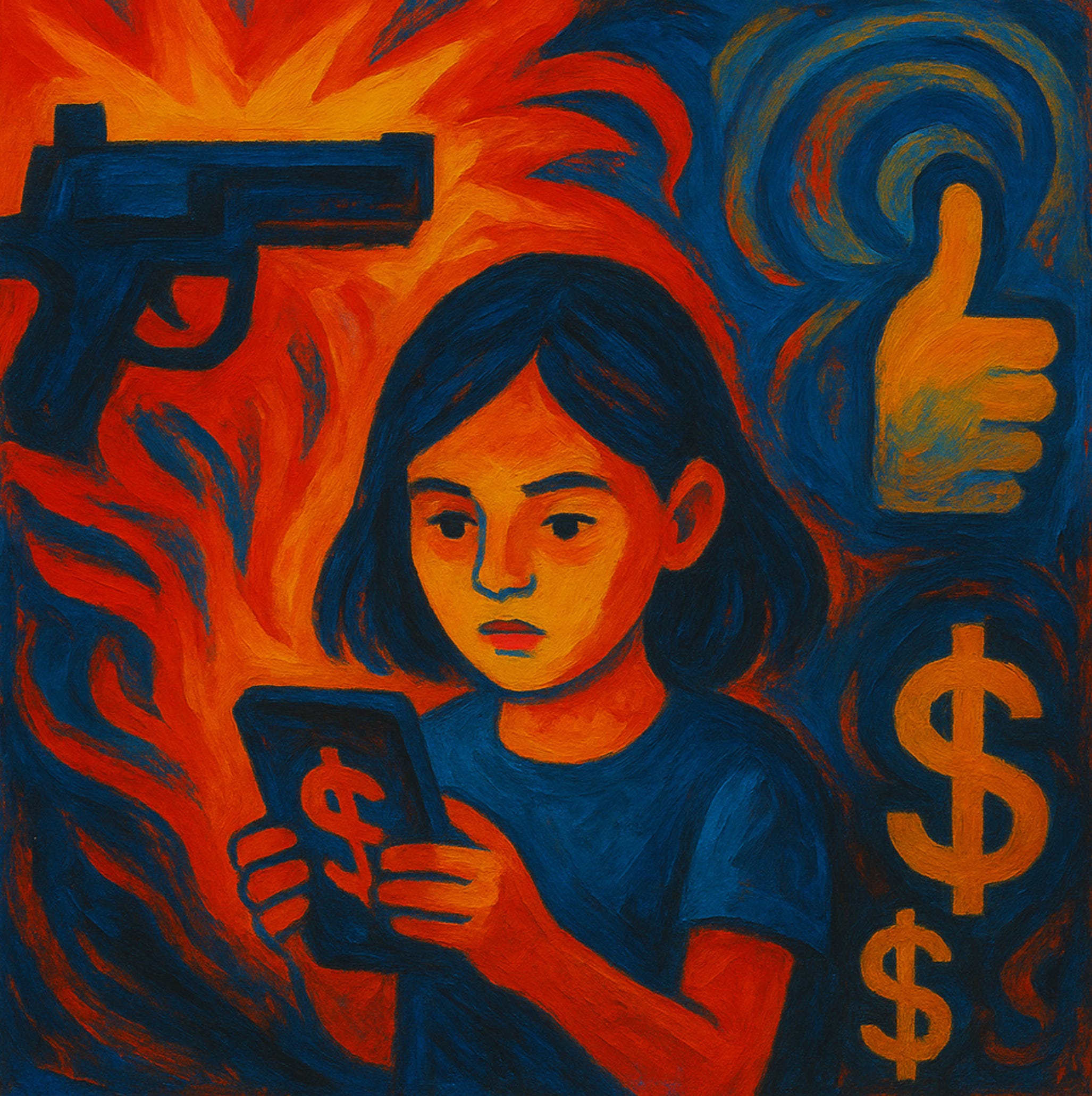
This is the feed that is raising our kids: political assassination and public murder spliced between homework reminders and group chats. At sixteen I was memorizing SAT vocabulary and trying not to fail parallel parking. At sixteen my daughter is studying a country that treats death as content.
Exclusion, Grievance, and the Feeling of Being Uncentered
High performance on diverse teams—across gender, race, religion, or class—is not mystical; it’s conditional. People thrive when they feel welcome, safe, valued, and championed. Frances Frei and Anne Morriss define these as the four pillars of inclusion in their book, Unleashed.² Remove them, and the sequence is predictable: exclusion breeds sadness, then anger. If leaders don’t acknowledge those feelings and rebuild trust, culture and performance rupture.
I saw this dynamic up close serving on the board of a company led by an old-school CEO. On paper, he said he wanted a younger, female, tech perspective. I checked those boxes. But when I raised points he didn’t want to hear—or didn’t want other directors to hear—the energy shifted: eye-rolls dressed up as jokes, the passive derision of a man guarding his turf.
One morning, by fluke, my blood sugar crashed and I fainted just before the board meeting was to start. A colleague caught me. The CEO’s first words weren’t “Are you okay?” but: “You’re not going to do a MeToo accusation over this, are you?”
That is what exclusion sounds like. The only woman in the room at the time, decades younger than everyone else—and that was his instinctive response. For a while I felt small, then furious. He was trying to rattle me into silence.
What mattered wasn’t my resilience but the presence of allies willing to look past his eye rolls and focus on the data I brought forward—information usually buried in footnotes that tied performance to stock price. The CEO eventually lost his role, not because I bested him, but because evidence and accountability did. Exclusion had sparked his defensiveness. Shared scrutiny turned rupture into repair.
It could have gone differently. He could have said, “I hear your points, even if they’re uncomfortable.” He could have acknowledged that he brought me on the board precisely for a different perspective, asked me to walk everyone through the analysis, admitted that feeling uncentered is difficult but necessary for the company to see its blind spots. That would have been hearing, not lashing out. And it might have strengthened him as a leader rather than isolated him.
This is the larger lesson. When people feel displaced, they can either weaponize grievance or lean into acknowledgment. The CEO chose grievance. But nationally, we could choose differently.
This is what my daughter was trying to decode about Charlie Kirk. After #MeToo and the reckoning that followed George Floyd’s murder, some young white men felt newly de-centered. Their power didn’t vanish, but their defaultness did—briefly. That glimpse of the margin could have birthed empathy: so this is what it feels like not to be championed. Instead, it hardened into grievance. Trump bottled it. Figures like Kirk sold it. Platforms amplified it.
When Lies Sprint and Truth Limps
If you want to study the machine, study the hours after Kirk was shot. Before facts existed, the takes did. Trump declared that “leftists” had created the climate that led to the assassination—and has not corrected himself.³ Elon Musk went further, posting that *“the Left is the party of murder.”*⁴ Other influencers blamed NGOs, the press, and Democratic donors.
As The Atlantic’s Charlie Warzel reported, the algorithmic internet abhors a vacuum; in the absence of facts, it fills the gap with rage-bait, conspiracies, and vitriol.⁵ By the time the suspect was in custody and details started to cohere—that the shooter was a 22-year-old Utah resident, Tyler Robinson, who came from a Republican family of gun owners and had expressed disdain for Kirk’s views as possibly not conservative enough—the narratives had already set like concrete.⁶
Warzel’s follow-up described how mass shooters now perform for one another, inscribing memes and names on guns, narrating their arsenals for the camera—“tactical gear as shitposting,” he called it—because the audience is part of the weapon.⁷
Violence, Virality, and Dollars
When Charlie Kirk was assassinated on camera, the video spread with ferocity. Millions watched it—some by choice, many because autoplay served it up before they could look away. The tragedy wasn’t just political. It was financial.
Platforms like YouTube, Instagram, and TikTok don’t sell content. They sell attention. Advertisers are the customers. We are the product. And a shocking clip is one of the most effective ways to hold us in place.
Even when platforms “demonetize” an assassination video—removing ads from the clip itself—it has already done its work. We stay. We click for context, reaction, commentary. That’s time on site. Time on site means auctions, and auctions mean revenue.
Rough economics (estimates): on YouTube, 10 million views on a monetized video can generate $25,000–$150,000; on Instagram, $10,000–$40,000; on TikTok, payouts are smaller, but a cross-platform clip that racks up 50 million views can easily trigger ~$500,000 in ad revenue—excluding the extra scrolling that follows.⁸
The caveat matters: all three companies say they prohibit monetization of violent content. But the structural truth is deeper. They don’t need to profit from the assassination video to profit because of it. Our horror keeps us scrolling. That scrolling is monetized. The model is agnostic. What matters is engagement. And nothing engages faster or deeper than shock. A man’s death is not only a tragedy; it is also, in the cold logic of the feed, a profitable event.
Guns + Feeds: A Fused System
Two technologies define the American present:
Guns, engineered for speed and lethality, insulated from the consumer-safety oversight we apply to cribs and car seats. Firearms are explicitly outside the Consumer Product Safety Commission’s jurisdiction.⁹
Feeds, engineered to maximize engagement and built atop adolescent attention. Nearly half of American teens say they’re online “almost constantly,” and large majorities use YouTube, Instagram, and TikTok every day.¹⁰
These systems interlock. One turns grievance into blood. The other turns blood into content—where it spreads, hardens, recruits. We treat the cycle as weather when it is architecture.
A Politics Equal to the Harm
America’s mistake, again and again, is to skip the reckoning. We euphemize slavery, backlash Reconstruction, tidy away Jim Crow, blur Vietnam and Iraq, wave past the financial crisis, downplay January 6. We pretend unity is amnesia. It isn’t.
Reconciliation is not everyone “getting along.” It is truth-telling with consequences. The South African Truth and Reconciliation Commission created a public record that looked the beast in the eye; Germany confronted abuses of the East German dictatorship in parliamentary inquiries after reunification. Neither process was neat. Both made denial harder.¹¹
What would an American reckoning look like for this era?
A Truth and Reconciliation Commission for Violence and Technology: survivors and families testifying; teenagers describing what it means to live with death on their phones; gun manufacturers, platform executives, and political leaders called under oath—not for theater, but accountability.
A public ledger of how exclusion → sadness → rage, when mixed with firearms + feeds, becomes a predictable pipeline.
We also need rules that treat kids’ safety as the design constraint, not the trade-off.
From “I’m Right, You’re Wrong” to Hearing Each Other
The cultural work is harder than the policy. When people feel unwelcome, unsafe, unvalued, and unchampioned, they don’t just go quiet; they curdle. The antidote isn’t endless performative debate. It is hearing.
In leadership workshops we teach HEAR:
Hear: I’m listening, not waiting to pounce.
Empathize: I can imagine how that felt.
Acknowledge: Your pain is real; I see it.
Respond: Here’s what I’ll do because I heard you.
Imagine if, after #MeToo and George Floyd, those who felt displaced took a collective beat to hear women and People of Color. And if those newly centered listened in return. Instead, Trump bottled grievance and sold it at scale. Figures like Charlie Kirk became the field sales force. The platforms were the distribution network.
Reconciliation is a national HEARING. Not “both-sides-ism.” A hearing is not endorsement; it’s recognition. The point is not to excuse; it’s to interrupt the sadness-to-anger pipeline before it reaches a gun or a camera.
The Generation Watching
My daughter is one child in a sea of children. Some are in Phoenix and Philadelphia; others in Charlotte or Kyiv. They share an internet. They share a vulnerability: a system that has turned the most intimate thing—a child’s attention—into a commodity to be captured, regardless of what it carries.
We can choose a different architecture. We can choose to design for welcome, safety, value, and championship as the first requirements, not the nice-to-haves. Or we can keep pretending that the cycle is fate.
Sixteen should be learner’s permits, first heartbreaks, and terrible parking jobs. Not first assassination, first public murder—all on the same screen.
Are we at war with our children? If we aren’t, we should stop building a world that behaves as if we are.
Notes & Sources
Ali Abbas Ahmadi, “Fatal stabbing of Ukrainian refugee in North Carolina ignites crime debate,” BBC News, Sept. 2025.
Frances Frei & Anne Morriss, Unleashed: The Unapologetic Leader’s Guide to Empowering Everyone Around You, Harvard Business Review Press, 2020.
“Trump blames leftists for Kirk assassination,” The Guardian, Sept. 12, 2025.
Charlie Warzel, Something Is Very Wrong Online, The Atlantic, Sept. 12, 2025.
Ibid.
“Who is Tyler Robinson, the suspect in custody for shooting Charlie Kirk?,” BBC News, Sept. 2025.
Charlie Warzel, The Mass Shooters Are Performing for One Another, The Atlantic, Sept. 4, 2025.
Author’s calculation based on published platform creator-fund estimates: YouTube Partner Program, Meta Creator Studio, TikTok Creator Fund.
U.S. Consumer Product Safety Commission, “Jurisdictional Limits”, and Rep. Debbie Dingell, “Defective Firearms Protection Act” proposal, 2024.
Pew Research Center, “Teens, Social Media and Technology 2023”, Dec. 11, 2023.
Human Rights Watch, Germany’s Renewal: Lessons from Reunification, 1992; Truth and Reconciliation Commission of South Africa, Final Report, 1998.
Heartbreaking to read because it's so on point. In Australia, social media is banned for kids 16 and under—the Prime Minister said, 'Parents, I see you and I have your back.' Imagine if we had that thinking here?? We seem so far from all common sense, sadly, and it's truly painful.
Excellent article today. Appreciate the thoughtful comments. I am curious about what plan beyond your commentary you have to engage in the political process.
best wishes,
Ward (Class of 65)